
Indian Research Scholars Association
Organizing
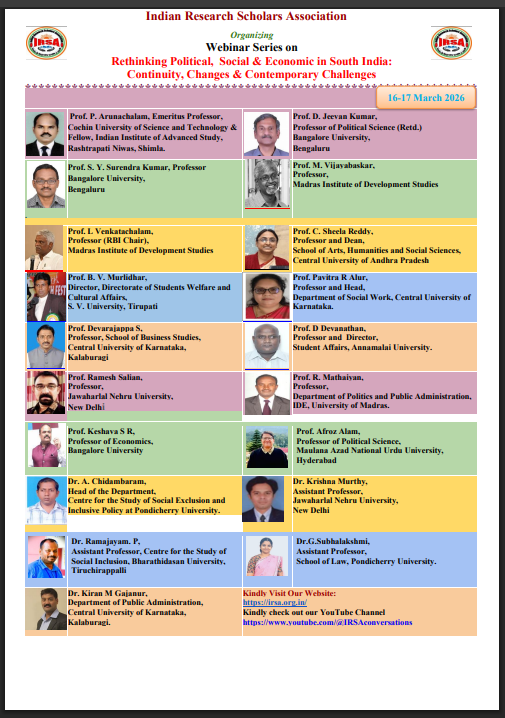
Webinar Series on
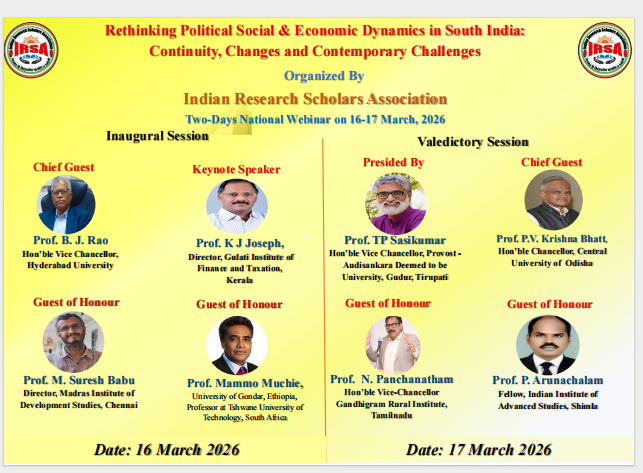
Rethinking Political, Social & Economic Dynamics in South India: Continuity, Changes & Contemporary Challenges.
During March 16-17, 2026
************************************************************************
Webinar Series Overview:
The Indian Research Scholar’s Association is going to organize a webinar series on “Rethinking Political, Social, and Economic Dynamics in South India: Continuity, Change & Contemporary Challenges.” It aims to explore the rapidly changing political, economic, and social landscape of India’s south region. This series will bring together scholars, policymakers, researchers, and academicians to engage in insightful discussions on governance, economic development, ethnic identity, and policy interventions in the region.
South India has played a distinctive role in shaping India’s political landscape. With strong regional identities, influential social reform movements, and alternative development models, the region offers a unique perspective on governance, federalism, and democratic practices. Rethinking South India politics involves examining historical roots, contemporary dynamics, and emerging challenges in the changing national and global context. The key states in this region of India include Tamil Nadu, Karnataka, Kerala, Andhra Pradesh, and Telangana.
The interactive sessions of the webinar will highlight key challenges, opportunities, and transformative policies that can drive sustainable growth and political stability. The discussions will delve into critical themes such as economic integration, border trade, governance models, ethnic diversity, and the role of central and state policies in shaping the region’s future.
Objectives of the Webinar Series:
- Understanding the Political Landscape: To analyze the evolving political scenario in South India, including regional governance structures, electoral trends, and policy frameworks.
- Economic Growth and Development: To explore economic challenges and opportunities, including trade, infrastructure, entrepreneurship, and sustainable development in the region.
- Socio-Cultural and Ethnic Dynamics: To examine the role of ethnic diversity, identity politics, and cultural heritage in shaping the socio-political fabric of South India.
- Role of Technology and Digital Economy: To discuss how digital transformation and technological advancements are reshaping governance and economic activities in South India.
- Security and Geopolitical Considerations: To evaluate security concerns, insurgency issues, and geopolitical influences affecting the region’s stability and growth.
- Encouraging Collaborative Research and Dialogue: To create a platform for scholars, researchers, and policymakers to share insights, propose policy recommendations, and collaborate on research initiatives.
Key Themes and Contemporary Issues in South Indian Politics
1. Regional Identity & Language Politics
- Role of language movements (Tamil, Telugu, Kannada, Malayalam)
- Resistance to cultural homogenization
- Impact on the federal structure of India
2. Dravidian & Social Justice Movements
- Dravidian ideology in Tamil Nadu
- Anti-caste movements and social reforms
- Reservation policies and inclusive governance
3. Political Parties & Leadership Patterns
- Strong regional parties vs national parties
- Personality-driven politics
- Coalition politics and electoral strategies
4. Governance & Development Models
- Kerala Model of Development
- Welfare-oriented governance
- Human Development Index performance
5. Centre–State Relations
- Federalism and autonomy
- Fiscal issues and policy disagreements
- Role of southern states in national politics
6. Emerging Trends & Challenges
- Youth and digital political engagement
- Urbanization and migration
- Gender representation
- Role of media and social platforms
This webinar series seeks to offer a contemporary perspective on South India’s evolving political and economic realities while fostering meaningful academic & policy-driven discussions.
Faculty members, research scholars, and students can apply. Interested participants are requested to fill out the Google form to register. There is no need to send a hard copy of the form. However, a copy of the filled form can be emailed to the email ID irsa.ac.in121@gmail.com.
Registration can be done online using the link given below:
If clicking the link does not open, you can copy the link and paste it into Chrome and fill out the Google form.
Participants can also apply this through the registration form, which is in this brochure; take the print, fill and send it to irsa.ac.in121@gmail.com
The certificate will be issued to the participants after completing the Webinar within 10-15 days.
Registration Fees: 200 only
Last date of Registration: 05/03/2026
Payment Details:
Name: Shubhangi Amble
Bank Account No.: 80084788213
IFSC Code: MAHG0004515
Bank Name: Maharashtra Gramin Bank
You can also pay with Phone Pay
Contact No. of the Committee Members:
Shubhangi Amble: 9822756495
Dr. Hemant Kumar: 996886006
For any query, you can send a message to WhatsApp: 9919914900
For any query, you can send a message to Mail: irsa.ac.in121@gmail.com
Website: www.irsa.org.in
YouTube Link: https://www.youtube.com/@IRSAconversations/about
Facebook\page:facebook.com/profile.php id=100089905803854&mibextid=ZbWKwL
WhatsappLink: https://chat.whatsapp.com/H923mD2xt3N0zu2D19aFpH
TwitterLink:https://twitter.com/research13613/status/1717121881047027889/photo/1
Linkedin:https://www.linkedin.com/in/indian-research-scholars-assocaition-76503b297/
Gmail: irsa.ac.in121@gmail.com
About the Indian Research Scholars Association: The India Research Scholars Association is a platform whose objective is to exchange creative, constructive, promotional, and progressive dialogue with research scholars in all the universities, colleges, and research institutes of India doing research in the subjects of Social Sciences, Humanities, Commerce, and Management. Through this platform, subject experts’ lectures are organized, and research-related information is shared. Lectures have been organized on research methodology, contemporary issues, research dynamics, and topics. Researchers at various universities, colleges, and research institutes operate this platform. Whose selection is done according to work done in their particular field. In this, lectures related to research are organized by subject experts and research scholars. So that the flow of logic and language can be developed in their works and communication style, this platform welcomes all those research scholars of India who are active in Research work.
Mission:
Our primary mission is to empower researchers, academicians, and students by providing them with the necessary tools, guidance, and platforms to excel in their academic pursuits. We believe in sharing knowledge free of cost because knowledge is for sharing, not for sale. We aim to foster a community that values knowledge sharing, interdisciplinary collaboration, and the development of cutting-edge research methodologies. IRSA aims to connect research scholars on one platform to exchange creative, constructive, promotional, and progressive dialogue with research scholars in all the universities, colleges, and research institutes of India.
Achievements: Our first major achievement is successfully bringing researchers from across the country together on a single platform. With a proven track record of organizing successful events, including two 10-day workshops on ‘Data Analysis Using SPSS Software’ and a one week national level e-workshop on ‘Enhancing Research Paper Writing Skills’. We have garnered a large number of participation from leading academicians, researchers, and students across India. Our lecture series, workshop and also book discussion sessions have been successful in reaching every state and UTs of our country. Consequently, 2000+ young researchers have connected with IRSA from all over India on various social media platforms. Delegates from various countries like the USA, France, Germany, Russia, and Bangladesh have visited this virtual platform and shared their knowledge and experiences. We have successfully conducted 50+ lectures, 10+ book discussions, and three workshops with the participation of vice chancellors, professors, researchers, and professionals. These sessions have provided a platform for insightful discussions on topics such as key concepts of research methodology, how to develop a questionnaire, how to avoid mistakes during research, hypothesis testing, and many more; book discussions on various contemporary issues like Reimagining Innovation Systems in Covid and Post Covid, Globalization and Sustainable Development, Internal Security and so on have received positive feedback for their depth and relevance.